
Learner Zone
Motor Vehicle HubEngine Repair
The engine is the heart of your car. To withstand its heavy workload, it must be a robust structure.
It consists of two basic parts: the lower section is the cylinder block and the detachable upper cover is the cylinder head.
The cylinder head contains valve-controlled passages that the air and fuel mixture travel through to enter the cylinders.
The cylinder block houses the crankshaft, which converts the reciprocating motion of the pistons into rotary motion at the crankshaft. The block also houses the camshaft, which operates mechanisms that open and close the valves in the cylinder head.
configurations
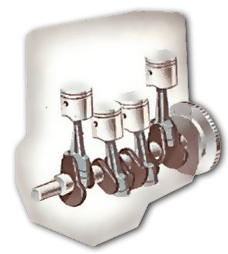
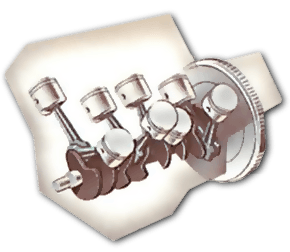
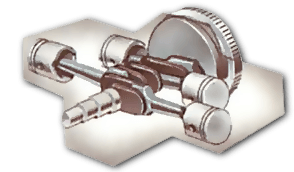
Watch these videos to learn about engine configurations and operating systems and the major components of an engine in more detail.
cooling
A car engine produces heat when it is running, and must be cooled continuously to avoid damage. Generally this is done by circulating coolant liquid (water mixed with antifreeze) through special cooling passages. Some engines are cooled by air flow.
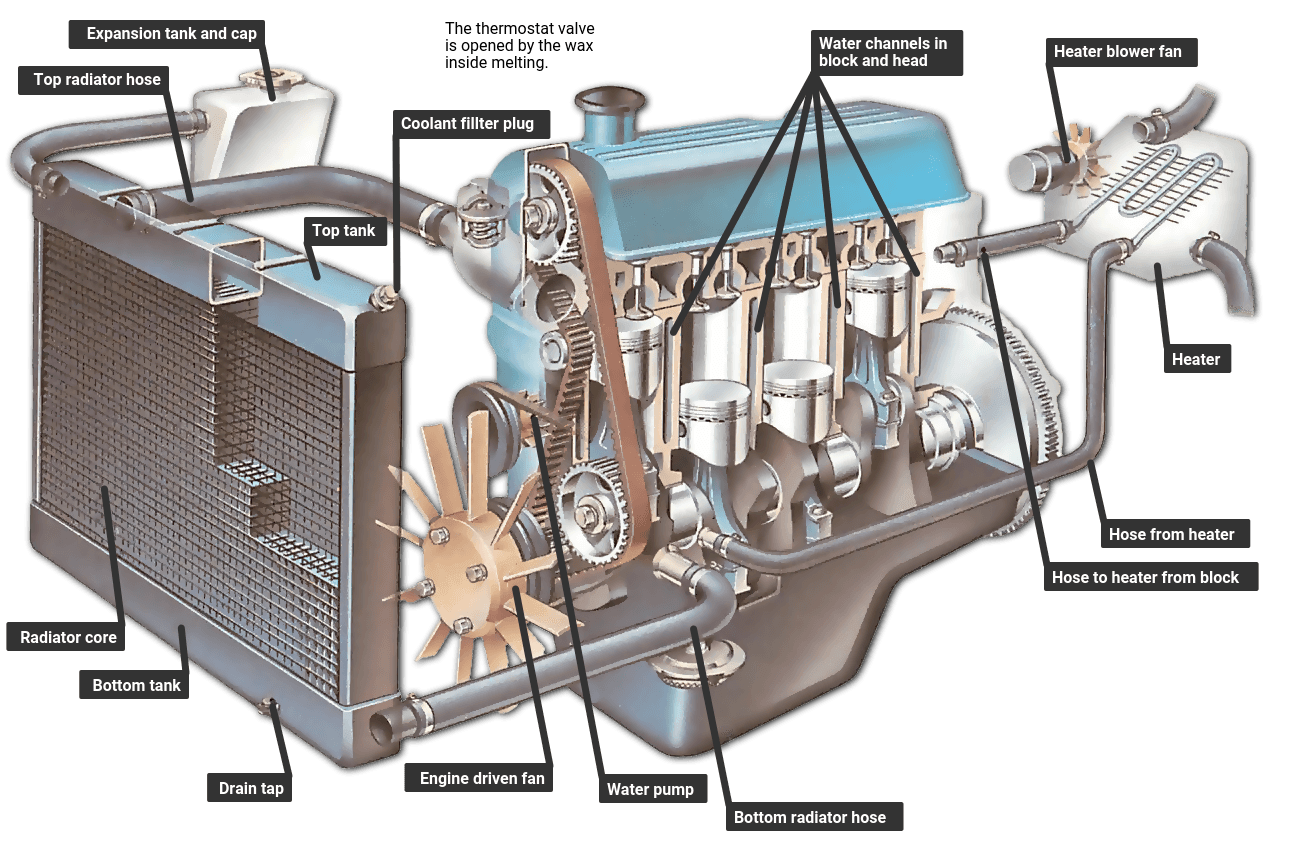
A water cooled engine block and cylinder head have interconnected coolant channels. At the top of the cylinder head all the channels converge to a single outlet. A pump driven by a pulley and belt from the crankshaft drives hot coolant out of the engine to the radiator. Heat is passed from the radiator into the air stream and the cooled liquid returns to an inlet at the bottom of the block, then flows back into the channels.
The pump sends coolant up through the engine and down through the radiator. The radiator is linked to the engine by rubber hoses and has a top and bottom tank connected by many fine tubes. The tubes pass through holes in a stack of thin sheet metal fins, so the core has a very large surface area and can lose heat rapidly to the cooler air passing through it. On older cars these tubes run vertically, but modern, low-fronted cars have crossflow radiators with tubes that run from side to side.
In an engine at its ordinary working temperature, the coolant is just below normal boiling point. The risk of boiling is avoided by increasing the pressure in the system, which raises the boiling point. The extra pressure is limited by the radiator cap, which has a pressure valve in it. Excessive pressure opens the valve and coolant flows out through an overflow pipe. In a cooling system of this type there is a continual loss of coolant if the engine runs very hot. The system needs topping up from time to time.
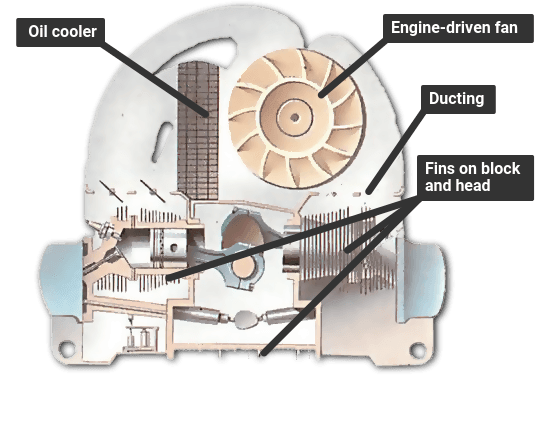
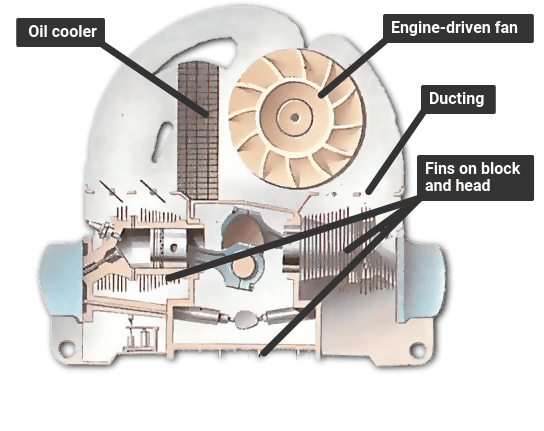
In an air cooled engine, the block and cylinder head have deep fins on the outside. A duct runs around the fins, and an engine driven fan blows air through the duct to take heat away from them. A temperature sensitive valve controls the amount of air being pushed around by the fan, and keeps the temperature constant even on cold days.
Watch this video to wrap up what you have learned about cooling systems.
lubrication
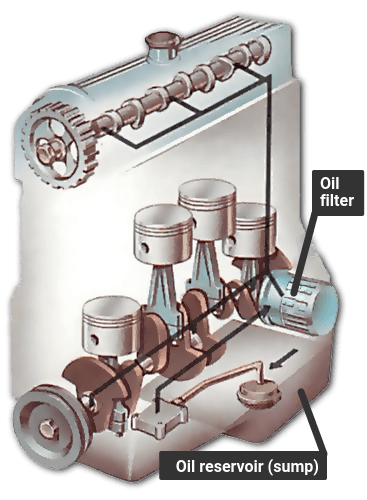
Friction between moving metal parts in the engine is minimised by a thin film of oil. Stored in a reservoir (the sump) at the bottom of the engine, the oil is sucked into the pump which sends it through various pipes and channels to the moving parts of the engine and then back to the sump.
The oil is circulated under pressure at a rate of several gallons per minute. The pressure is controlled in the pump by a relief valve. When the pressure is excessive, it leaks some of the oil back to the sump. Oil forced out of the crankshaft journals is thrown against the cylinder walls. This is known as splash lubrication. Before reaching the engine, the oil passes through a filter attached to the pump, which removes sludge and abrasive particles.
If the pressure drops or if there is an oil deficiency, the moving parts of the engine wear rapidly and eventually seize.
Watch this video to learn more about lubrication systems.
cycles